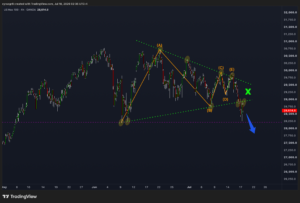
The Nasdaq 100 has broken below the triangle shown on my attached chart, retested the lower trendline from underneath, and resumed its decline.
That is clearly bearish in the short term.
For traders operating on the 1-hour and 4-hour timeframes, the current structure may present a strong short-side opportunity after futures reopen Sunday evening, assuming price continues to confirm the breakdown and offers a sensible entry with clearly defined risk.
But the larger picture matters.
We are not necessarily witnessing the end of the long-term bull market. The Nasdaq 100 is declining within a broader consolidation and correction inside an established upward trend.
That creates two very different perspectives.
Shorter-term swing traders may be looking for opportunities on the short side as the correction extends.
Longer-term investors may be better served by waiting for the decline to mature, allowing the corrective structure to complete, and then looking to buy the dip before the larger uptrend resumes.
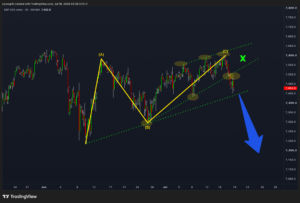
The S&P 500 is telling a similar story.
My primary bearish count identifies the recent advance as an ending diagonal completing wave C of a flat correction. On Friday, the index broke below the diagonal’s lower trendline, returned to test it from underneath, and then resumed lower.
Under my larger Elliott Wave interpretation, waves A and B of the broader ABC flat correction have completed, and wave C to the downside is now unfolding.
As always, I do not trade from one rigid prediction. I maintain multiple bullish and bearish counts, assign probabilities to each, establish validation and invalidation levels, and then let price action tell me which scenario the market has chosen.
Right now, the probabilities favour continued short-term downside within the larger correction.
Are you approaching this as a swing trader looking to trade the breakdown, or as a longer-term investor waiting for the correction to finish before buying the dip?
This analysis is for educational purposes only. I do not operate a trading signal service, and nothing in this post should be considered personalized investment advice.