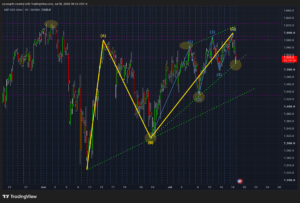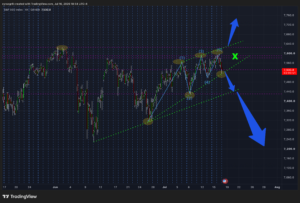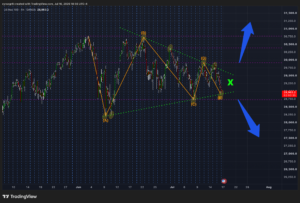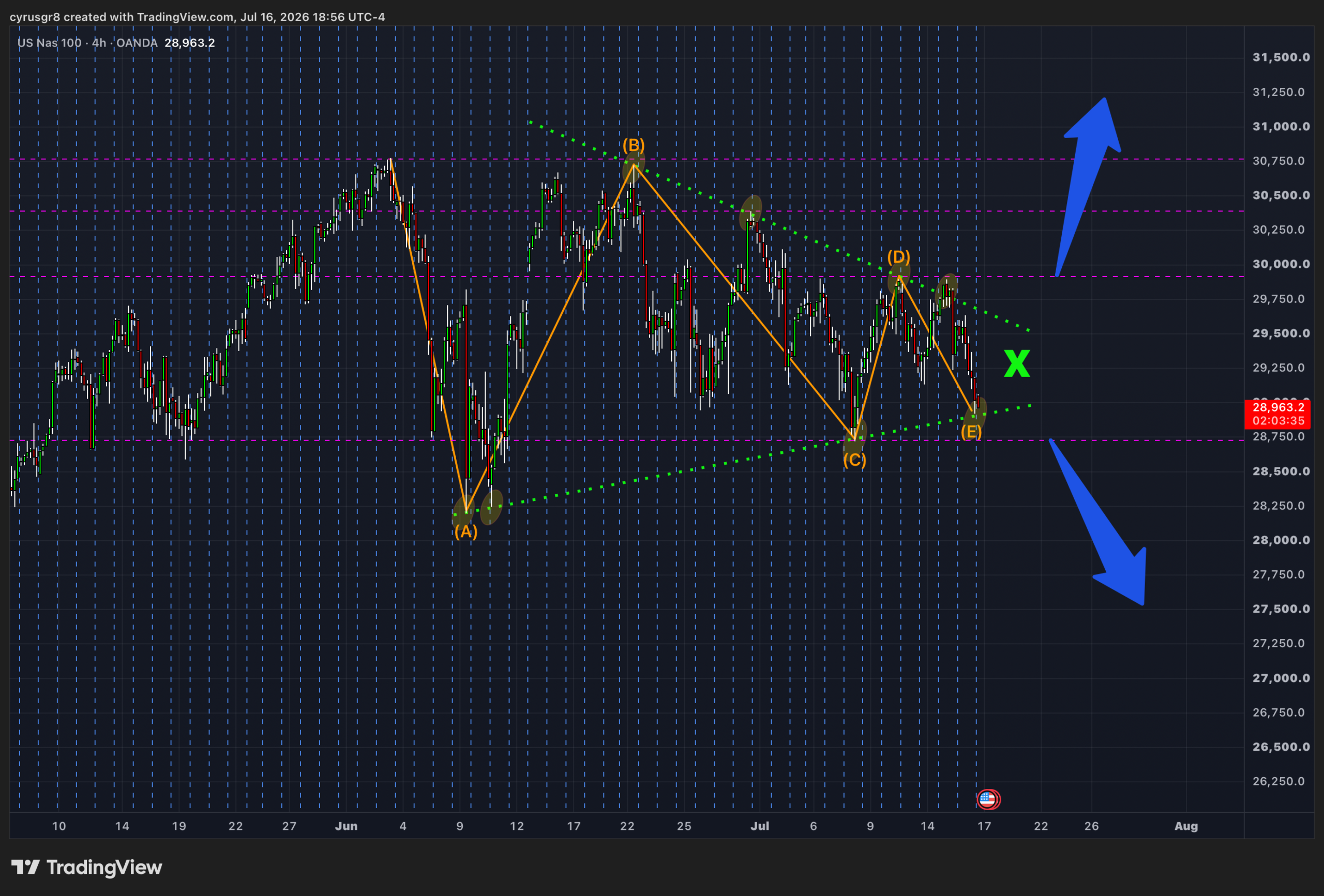
The past few sessions have been turbulent, yet the S&P 500 and Nasdaq-100 have ultimately gone nowhere. Both remain trapped in tightening consolidation, whipsawing traders in both directions without confirming a decisive breakout.
Neither index has validated the scenarios I outlined Sunday night.
The Nasdaq-100 is clearly compressing inside a narrowing triangle. The spring is tightening, and a significant move is likely approaching. Direction, however, remains unresolved. The next major move could be bullish or bearish depending on which side of the triangle price ultimately breaks.
The S&P 500 is the more interesting case.
On Sunday, I presented a possible triangle count in which the breakout may already have begun. Since then, however, price action has not behaved impulsively. Instead, we have seen overlapping mini-waves and repeated reversals. That is not convincing breakout behaviour, so that particular count is now invalidated.
This is exactly why traders need multiple counts, clearly defined validation and invalidation levels, and the discipline to let price action determine which scenario is unfolding.
The S&P’s most bearish count remains an ABC flat correction from the June 11 low, with wave C potentially forming an ending diagonal composed of five overlapping waves.
The most bullish count is that the advance from June 26 represents a leading diagonal wave 1.
So, how do we trade this?
We wait.
I have marked the levels where bullish or bearish breakouts would be confirmed, and where I would consider entering long or short.
Do not become emotionally attached to any single count. **Price action is king.** Let the market make up its mind, then demand confirmation before committing capital.
Do not try to be a hero by entering early because you are convinced price “must” move in one direction.
Most of trading is not trading. It is waiting.
Patience may feel unproductive, but over time it is rewarded through better entries, fewer unnecessary losses, and a higher win rate.